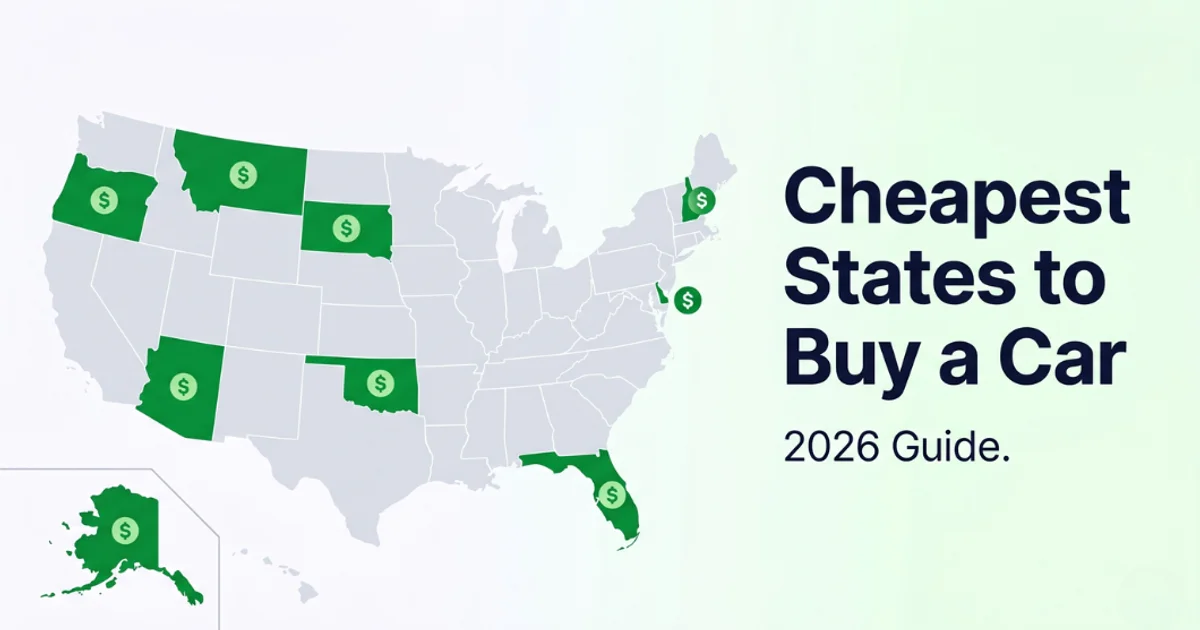

There is no single cheapest state to buy a car in 2026. Oregon, New Hampshire, Montana, Delaware, and Alaska charge no statewide sales tax, which makes them cheapest for their own residents; states such as Florida and Oklahoma offer deep used-car inventory and competitive pricing; and for an out-of-state buyer, the cheapest place depends on the vehicle’s price, dealer fees, your home state’s tax rules, and what it costs to bring the car home. Between tax rates that range from 0% to over 9%, documentation fees that differ by hundreds of dollars, and dealer markups that shift with local competition, the state where you buy can still change your total cost by thousands of dollars on the same vehicle.
The stakes are real: per the Bureau of Labor Statistics’ 2024 Consumer Expenditure report, the average American household spends $13,318 a year on transportation, and the tax and fee decisions made at purchase shape a meaningful share of that. For anyone willing to look beyond their home state, the best used car websites put every region’s inventory on one screen, which makes cross-state shopping practical rather than theoretical. There are catches most buyers overlook, though, and this guide covers them. New to the process? Start with our full guide on how to buy a car before picking your state.
Key Takeaways
- Five states charge no sales tax on vehicle purchases: Oregon, New Hampshire, Montana, Delaware, and Alaska.
- You pay sales tax in the state where the car is registered, not where you buy it. This is the single most misunderstood rule in out-of-state car buying.
- Beyond taxes, states like Florida, Oklahoma, and South Dakota save buyers through lower dealer markups and documentation fees rather than tax savings alone.
- Shipping costs from a cheaper state to your home state can eat into your savings, so run the full math before committing.
Are Cars Cheaper in Different States?
Yes, and sometimes by a wide margin. A car purchase is not just the sticker price; it is the sticker plus state sales tax, plus county and city taxes, plus documentation fees, plus registration and title costs, plus any required inspection or emissions fees. All of these vary by state, and the gap between the cheapest and most expensive states on a $35,000 vehicle can reach $3,000 or more once everything is accounted for.
The single biggest variable is sales tax. Some states charge combined state and local rates above 9%, while five states charge nothing at all. On a $35,000 car, a 9% rate means $3,150 in tax that a buyer registering in a no-tax state never pays. Documentation fees add another wide range, from under $100 in fee-capped states to several hundred dollars where they are unregulated, and local dealer competition influences how much margin is built into the sticker price in the first place.
Benefits of Buying a Car Out of State
Three reasons buyers cross state lines for a vehicle purchase:
- Lower taxes and fees. The most measurable benefit. A state with no sales tax can save thousands upfront, though as we explain below, the savings do not always transfer when you register at home.
- Wider selection. Larger metropolitan markets often carry deeper inventory of specific makes, models, trims, and colors, especially for used or enthusiast vehicles.
- Better used car condition. Southern and western states like Florida, Texas, and Arizona have lower rates of rust and corrosion than Northeast and Midwest states with road salt exposure, meaning used vehicles typically present in better condition at similar prices.
The math only works out if the total cost, including transport to bring the car home, comes in below what you would pay locally. That is where out-of-state car buying gets strategic.
Cheapest States to Buy a Car in 2026
Here is the field at a glance, followed by the case for each state:
| State | State-level vehicle tax | Best for |
|---|---|---|
| Oregon | 0% (0.5% use tax on new) | Residents; low capped doc fees |
| New Hampshire | 0% | Residents; Northeast inventory access |
| Montana | 0% | Residents; low registration on older vehicles |
| Delaware | 0% | Residents; Mid-Atlantic shoppers, low doc fees |
| Alaska | 0% state (local up to 7%) | Alaska residents only, in practice |
| South Dakota | 4% excise | Lower-tax residents; lowest doc fees |
| Oklahoma | Standard | Central-market price comparison |
| Florida | 6% | Large used inventory, dealer competition |
| Arizona | Standard | Dry-climate used cars, declining license tax |
Oregon
Oregon charges no state sales tax on vehicle purchases, which immediately puts it among the cheapest states for any significant car purchase. Documentation fees are capped at a relatively low level by state law, well below the national average. Combined with an established dealer network across Portland, Eugene, and Salem, Oregon is a consistent top pick for buyers shopping for new vehicles at higher sticker prices.
Oregon does charge a small vehicle use tax on new vehicles (0.5%), but for a $40,000 car, an out-of-state buyer still typically saves $2,000 or more compared to a purchase in a 7 to 8% sales-tax state, before factoring in the cost of shipping a car from Oregon home.
New Hampshire
New Hampshire has no state sales tax on vehicles, no statewide inspection fees, and generally modest registration costs. The state benefits from proximity to dense used-car markets in the Boston metro area, giving buyers strong inventory options without having to buy in higher-tax Massachusetts, and car shipping from New Hampshire to anywhere on the East Coast is short-haul and cheap.
The tradeoff for New Hampshire residents is that some municipalities charge a higher annual property tax on vehicles, which partially offsets the upfront savings if you will own and register the car there long-term. For out-of-state buyers, the upfront advantage is what matters.
Montana
Montana charges no state sales tax and has relatively low registration fees, particularly for older vehicles. It is also associated with LLC-based vehicle registration strategies used by some high-value vehicle owners. Whether such an arrangement complies with tax and registration law depends on the owner’s home state and circumstances, and several states actively scrutinize these structures, so anyone considering one should obtain state-specific legal or tax advice first.
For standard buyers, Montana’s tax-free status is most valuable if you live there, are relocating, or are comfortable arranging vehicle transport from Montana from a less-central location.
Delaware
Delaware charges no sales tax on vehicles and has some of the lowest average documentation fees in the country. Registration and title fees are also modest. The state’s small size limits selection compared to larger markets, but for shoppers willing to travel or arrange car shipping from Delaware, it can deliver meaningful savings, especially on higher-priced vehicles where tax differentials matter most.
Alaska
Alaska has no state sales tax, though some municipalities charge local sales tax of up to 7%. For buyers already in-state, this is a strong cost advantage. For everyone else, there is a major catch: shipping a car from Alaska to the contiguous United States is expensive and logistically complex, often starting at $2,000 and above. Alaska makes the no-tax list on fundamentals, but in practice only a narrow set of buyers benefit.
South Dakota
South Dakota charges a 4% vehicle excise tax, well below the 6 to 8% combined rates in most of the country, and has no statewide vehicle inspection requirement. Documentation fees are among the lowest nationally. The state’s rural dealer network means selection is limited in some categories, but for buyers in the Upper Midwest or those willing to arrange transport from South Dakota, it is a quiet standout.
Oklahoma
Oklahoma does not have the zero-tax advantage of the top five, but it is worth comparing for buyers in the central U.S. because of its sizable used-car inventory, relatively modest documentation fees, and steady dealer competition, with car shipping from Oklahoma benefiting from its position on major east-west carrier routes.
For buyers prioritizing bottom-line price over tax structure, Oklahoma is often the smart pick.
Florida
Florida has one of the largest, highest-volume used-car markets in the country, giving shoppers broad inventory and strong dealer competition, with high turnover and seasonal-resident sales adding steady supply. That competition can produce attractive listing prices on many models, though two caveats apply: the state’s 6% sales tax is not low, and Florida’s dealer doc fees are often $500 or more and uncapped, so compare out-the-door numbers rather than stickers.
Florida is also one of the top origins for cross-country car shipping to the Northeast and Midwest, making it a practical source for buyers outside the state.
Arizona
Arizona has a competitive used-car market, particularly in the Phoenix and Tucson metro areas. The state’s vehicle license tax replaces traditional property taxes on vehicles and decreases each year a car is owned, which lowers long-term ownership costs. For buyers shopping used vehicles in strong cosmetic condition with minimal rust and road salt exposure, Arizona is a reliable option.
Why Are Cars Cheaper in Some States?
Three main factors explain the price variations between states:
- State sales tax rates. The biggest variable. States range from 0% (Oregon, New Hampshire, Montana, Delaware, Alaska) to above 9% in parts of California and Tennessee.
- Documentation and administrative fees. Dealer-charged paperwork fees range from under $100 in states that cap them by law to several hundred dollars where they are unregulated, added directly to the out-the-door price.
- Local market competition. States with denser dealer networks and higher transaction volume tend to have tighter margins and more aggressive pricing, especially in the used-car segment.
Differences in Registration and Documentation Fees Across States
Beyond sales tax, the cost of titling and registering a vehicle varies widely. Based on published state fee schedules as of 2026:
- Low doc fees: Minnesota ($75 cap), Arkansas ($110 cap), Oregon and South Dakota (around $115), Iowa ($135).
- High doc fees: Florida (often $500 or more, uncapped), California (doc fee capped at $85 but other state fees are significant), New York ($175 cap plus mandatory state fees).
Annual registration fees typically range from $20 to over $200 depending on vehicle type and weight, with additional variation based on emission standards or vehicle age requirements in certain states. Fee schedules change; confirm current numbers with the state DMV before you budget.
The Sales Tax Catch: You Pay Where You Register
This is the single most important rule to understand, and the one most out-of-state buyers miss: you pay sales tax in the state where you register the car, not in the state where you buy it.
That means if you live in California (7.25% state rate, often 9%+ combined with local taxes) and buy a car in Oregon (0% tax), you still owe California use tax when you register the vehicle back home, as the California Department of Tax and Fee Administration spells out for vehicles purchased out of state. The no-tax state’s sticker advantage does not transfer to your registration bill. Our guide to buying a car out of state lists which states collect tax from nonresident buyers at the sale and which home states refuse credit for it.
There are legitimate exceptions, such as relocations, military transfers, and certain LLC structures, but for a standard buyer the straightforward truth is that you do not avoid sales tax simply by crossing state lines.
What you can save by buying out of state:
- Dealer markup (lower sticker prices in competitive markets)
- Documentation fees (when they are lower in the purchase state)
- Better selection or condition for the same price
- Used-car value (less rust or wear in dry or warm states)
What Does It Cost to Ship a Car From These States?
Shipping costs depend on distance, vehicle size, and transport type (open vs. enclosed). Based on SAKAEM’s 2026 carrier-market pricing, typical open-transport quotes for a mid-size sedan headed to a major East or West Coast metro fall roughly within these ranges:
- Oregon → $800–$1,600 depending on destination
- New Hampshire → $400–$1,400
- Montana → $900–$1,600
- Delaware → $400–$1,100
- South Dakota → $900–$1,500
- Oklahoma → $800–$1,100
- Florida → $600–$1,500
- Arizona → $500–$1,500
Alaska shipping typically starts at $2,000 and above due to multi-modal logistics.
The math to run: start with the state’s sticker and tax advantage, then subtract your estimated shipping cost. You can check real prices for your exact route in our car shipping cost calculator. If the net is still meaningfully positive, the out-of-state purchase pays off. If it is not, buy local.
A quick example: say you live in Texas (6.25% sales tax) and buy a $40,000 car in Oklahoma. Your home state’s tax applies at registration, so the upfront tax savings are modest. But if Oklahoma’s dealer markup and documentation fees save you $1,500, and shipping to Dallas runs roughly $900, your net savings is still $600 before factoring in better selection or condition.
Bottom Line
The cheapest state to buy a car in 2026 is Oregon, New Hampshire, Montana, Delaware, or Alaska if tax structure drives the decision, and Florida or Oklahoma if sticker price and selection matter more; either way, your home state’s sales tax applies at registration, so the real savings come from markup, fees, condition, and inventory, minus what it costs to bring the car home. When the math works, SAKAEM moves out-of-state purchases coast to coast, door to door. Get an instant quote for your route before you commit to the car.
Cheapest States to Buy a Car FAQ
What is the cheapest state to buy a car?
There is no single cheapest state for every buyer. Oregon, New Hampshire, Montana, Delaware, and Alaska have no statewide sales tax, which makes them attractive for their own residents. For out-of-state buyers, home-state tax still generally applies at registration, so vehicle price, dealer fees, condition, and shipping costs determine which state is actually cheapest for you.
How do I ship my car from another state?
After buying an out-of-state vehicle, you will need to arrange transport to your home state. Most buyers use a licensed auto transport company that coordinates pickup at the seller’s location and delivery to your door. SAKAEM handles nationwide interstate shipments daily; see our full walkthrough on how to ship a car for the complete process.
Is it better to buy a car online or in person?
Online purchases work well when you are buying from a reputable dealer in another state and need the convenience of remote paperwork. In-person purchases are better for unique or high-value vehicles where hands-on condition inspection matters. For standard models at competitive prices, online plus shipping is often the fastest and cheapest combined path.
When is the best time to buy a car for the lowest price?
Late December typically offers the best dealer pricing because salespeople and dealerships are closing out annual quotas. End-of-month and end-of-quarter transactions are smaller versions of the same effect. Model year transitions (August through October) are also strong windows; our guide to the best time to buy a car breaks the calendar down month by month.
Is it cheaper to buy a car in a state with no sales tax?
Only if you are a resident of that state. If you live elsewhere and register the vehicle at home, you will pay your home state’s sales tax at registration, not the purchase state’s. The no-tax state can still save you on dealer markup, documentation fees, or selection, but not on sales tax itself.
Can I avoid sales tax by buying in a no-tax state?
No, not as a standard buyer. Sales tax is owed in the state where the car is registered, not where it is purchased. Montana LLC registration structures exist, but whether one complies with tax and registration law depends on your home state and circumstances, and several states actively scrutinize them. Consult a tax professional before relying on any strategy that promises to bypass sales tax on a permanent vehicle registration.
Which state has the cheapest car registration fees?
Among the cheap-to-buy states, South Dakota and Oregon combine low registration costs with low documentation fees, and Montana’s registration fees drop significantly for older vehicles. Registration pricing is set by each state and often varies by vehicle weight, age, and fuel type, so check the DMV fee schedule for any state you are comparing.
How much does it cost to ship a car from the cheapest states?
For a mid-size sedan on open transport, expect roughly $400 to $1,100 from East Coast states like Delaware and New Hampshire, $600 to $1,600 from Florida, Arizona, and the Pacific Northwest, and $800 to $1,600 from interior states like Montana, South Dakota, and Oklahoma, with Alaska starting around $2,000 due to the ocean leg. Exact pricing is market-rate for your specific route and dates.